

A Difficult Patient
In "Misunderstood," I wrote about what it's like to walk through the world in a body people think they understand at a glance. The assumptions. The judgments. The way a stranger's eyes land on you and decide they already know your story.
But there's a version of that experience I didn't get into — the one that happens when you try to correct the record. When you open your mouth and say, “Actually, that's not what's going on here.” When you hand provider peer-reviewed literature and watch them set it aside. When you point out that your billing code doesn't match your diagnosis, and the person on the other end of the phone tells you they'll just change it to something else — a condition you also don't have — "so they can get paid."
That's when you stop being misunderstood and start being difficult.
I didn't start out difficult. I started out hopeful.
I'd been told I might have a serious neurological condition. I was scared. I showed up to a new provider's office with my records organized, my symptom history documented, my questions written down. He told me he was on my team. He said I was complex, but he'd help me figure things out. I believed him.
By the follow-up appointment, he'd forgotten his own promise. It was all about my weight. Lose weight. Take this pill. Take that pill — never mind that both drugs he pushed carried suicidal ideation as a side effect, and I'd told him about my history. He wasn't listening. He was running a script.
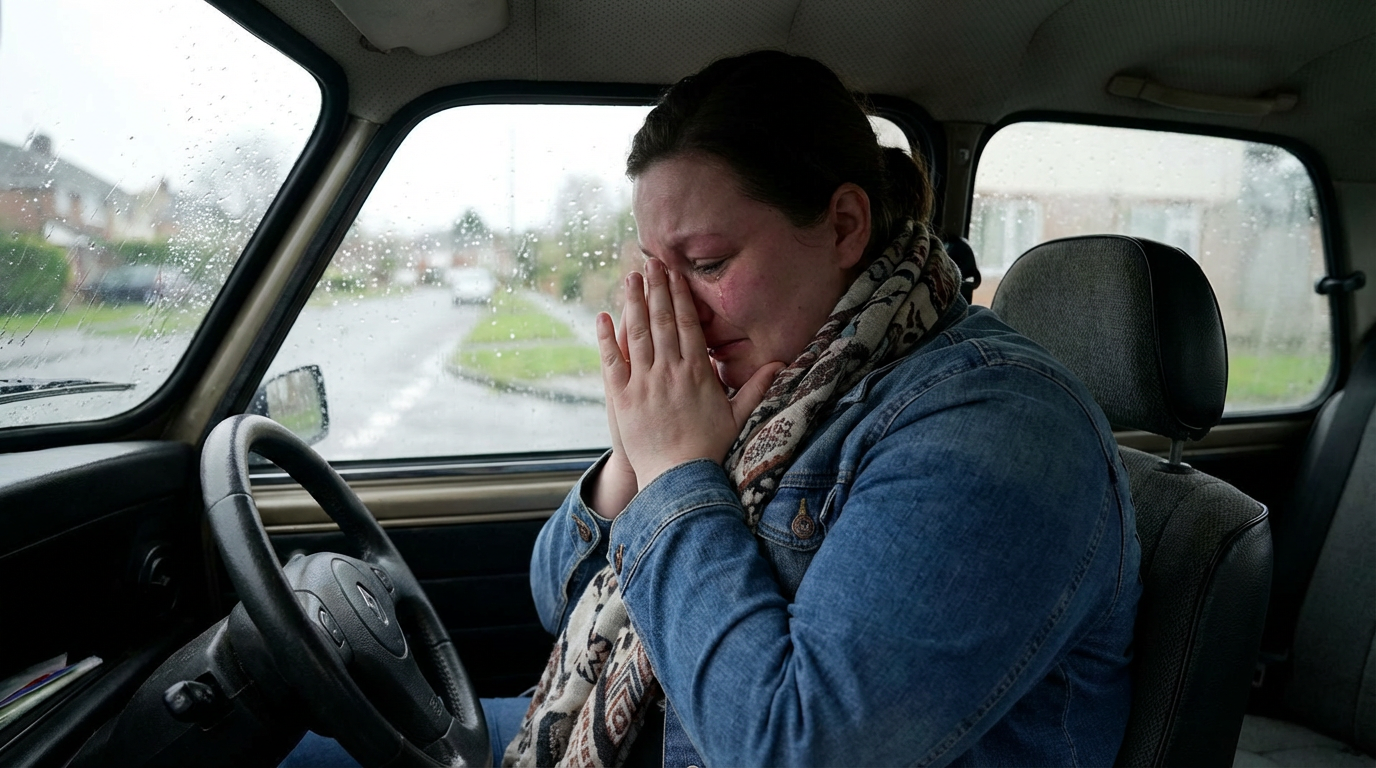
A woman cries in her car - image made with Runway AI
I sat in my car afterward and cried. Not because I was surprised — I've written about what it's like to be a zebra, to be one of those patients whose conditions don't fit the textbook. I knew the odds weren't great. But I'd let myself hope, and that made the betrayal worse.
Here's the part I'm not proud of: my first instinct wasn't to fight. It was to protect him.
He was young. A couple years out of residency. I know there's a doctor shortage in my area. I thought about his career, his patients, the system that trained him to see weight as a moral failing rather than a symptom. I ordered educational brochures from the Lipedema Foundation and had them shipped to his office, hoping that if he just understood the condition, he'd do better.
I need you to sit with that for a second. A patient who was harmed spent her own money trying to educate the provider who harmed her. Not because she's a saint, but because she was trained from childhood to protect people who hurt her. That instinct — the one that says maybe if I'm nicer, maybe if I make this easier for them, maybe if I don't make waves — that's not wisdom. That's a trauma response wearing wisdom's clothes.
When the brochures didn't work and the behavior continued, I did file a complaint. Through the proper internal channels. I was respectful, organized, specific. I included documentation. I followed up within their stated timelines.
Their risk management department responded by telling me the problem was my "expectations."
Not his conduct. Not the billing codes that contradicted his own clinical notes. Not the contraindicated medications he pushed. My expectations.
I wrote about the desert in my first post on this blog — the geographic desert, the medical desert, the diagnostic desert. But there's another desert I didn't name then: the institutional desert. The one where you follow every procedure, exhaust every internal channel, document everything, and the system responds by telling you that expecting basic competence makes you the problem.
That's not an accident. It's a design.

A doctor thinks, “But did you know you’re fat?” - image made with Runway AI
Here's what I've learned about institutional silence, and I want every chronic illness patient, every rare disease patient, every woman who's ever been told to lose weight instead of being diagnosed to hear this:
The system is not broken. It is working exactly as designed. It is designed to exhaust you.
Every form you fill out that goes nowhere. Every voicemail that isn't returned. Every "final determination" that ignores your evidence. Every month you wait for a response while your medical records continue to carry false information. That's not incompetence. That's a strategy. The longer they wait, the more likely you are to give up.
I wrote in "Zebras" about the medical saying: when you hear hoofbeats, think horses, not zebras. Rare disease patients already know the system isn't looking for us. What I've learned since is that the system is also built to make sure we stop asking to be found.
They count on your exhaustion. They count on your isolation. They count on your politeness, your trauma response, your tendency to assume you must be wrong because everyone in a position of authority seems to think so.
They especially count on your silence.

A beautiful woman SPEAKS UP - image made with Runway AI
Speaking up does not feel like empowerment. I want to be honest about that, because the self-advocacy content online can make it sound like you just need to find your voice and everything changes. That's a fantasy.
Speaking up feels like being labeled difficult. It feels like watching people's body language change when you push back. It feels like spending your limited energy — energy you need for managing your actual conditions — on paperwork and phone calls and carefully worded letters and documentation that no one reads.
It feels like being punished. I've had prescription costs tripled after filing a complaint. I've had my records correction requests denied. I've had risk management call me with suspicious timing after a new diagnosis confirmed everything my previous providers dismissed.
It gets harder before it gets easier. That's the truth no one tells you.
But here's the other truth: it works.
Not immediately. Not cleanly. Not without cost. But the documentation you build becomes undeniable. The pattern you identify becomes impossible to explain away. The diagnosis you were right about eventually gets confirmed by someone willing to look.
I spent decades being told my symptoms were anxiety, depression, weight. I now have confirmed diagnoses for conditions that explain every single thing that was dismissed. Every. Single. One. I didn't get those diagnoses by being quiet. I got them by being the difficult patient — the one who kept showing up with data, with research, with questions that made providers uncomfortable.

An intelligent woman presents research to a doctor - image made with Runway AI
I think about the women I wrote about in "Big Legged Women." My great-grandmother in her wheelchair, diagnosed with gout in the 1950s when it was almost certainly lipedema. My aunt, bedridden until she died at 52. My cousin, dead at 32 from an aneurysm. The women in old photographs with legs that look like mine, expressions that read as angry but were probably pain.
They didn't speak up because there was nothing to say. They didn't have the words. There were no names for what was happening to their bodies. There was no internet, no TikTok algorithm surfacing rare disease content, no foundation shipping brochures, no AI helping them build a medical case at 3 AM because they had no one else to turn to.
I have all of that. And I almost didn't use it because my first instinct was to protect the man who dismissed me.
If that doesn't tell you something about how deep the conditioning goes — the conditioning to be agreeable, to not make trouble, to assume the person with the degree must be right and you must be wrong — I don't know what will.
So here's what I want to say to you, if you're reading this and recognizing yourself:
You are not difficult. You are necessary.
The fact that you noticed the discrepancy in your records, that you questioned the diagnosis that didn't fit, that you asked why the billing code contradicts the clinical notes — that's not a personality flaw. That's pattern recognition. It might even be the same pattern recognition that kept you alive through whatever else you've survived.
The system will tell you you're the problem. Risk management will call your documented concerns a matter of "expectations." Providers will sigh when you pull out your notes. The billing department will promise to fix things and then not fix them. This will happen more than once. It will happen for months. You will wonder if you're crazy.
You're not crazy. You're inconvenient. There's a difference.
And the discomfort you feel about speaking up — the guilt, the urge to apologize, the voice that says maybe I'm overreacting, maybe I should just let this go — examine where that comes from. For many of us, especially those of us with trauma histories, the instinct to protect people who harm us is so deeply wired that it feels like our own thought. It's not. It's the scar tissue of old survival strategies that no longer serve us.
You can honor the part of you that learned to stay quiet and survive. And you can also decide that quiet isn't working anymore.

A beautiful woman owns her super powers at the doctor’s office. - image made with Runway AI
I'm still in the middle of my own fight. Complaints are filed. Records are wrong. The institution that caused the harm hasn't corrected it. I don't know how it ends.
But I know this: I have documentation that tells the truth, even if they won't put it in my chart. I have diagnoses that prove what I always knew. I have a team of providers — found through my own research, my own persistence, my own refusal to accept "lose weight" as an answer — who actually understand my conditions.
And I have a blog where I get to say, plainly: this happened. It was wrong. And if it's happening to you, you're not imagining it.
The difficult patients are the ones who change things.
Not because being difficult is fun, but because silence is what the system is banking on.
Don't give them what they're banking on.
