

Big Legged Women
The photograph is from the 1890s. My great-great-grandmother stands with her fists on her hips, staring down the camera in a stance her eight surviving children probably knew well. She's wearing a multi-layered skirt, the fashion of the time, but you can still see it — the width of her hips, the shape of her legs beneath the fabric.
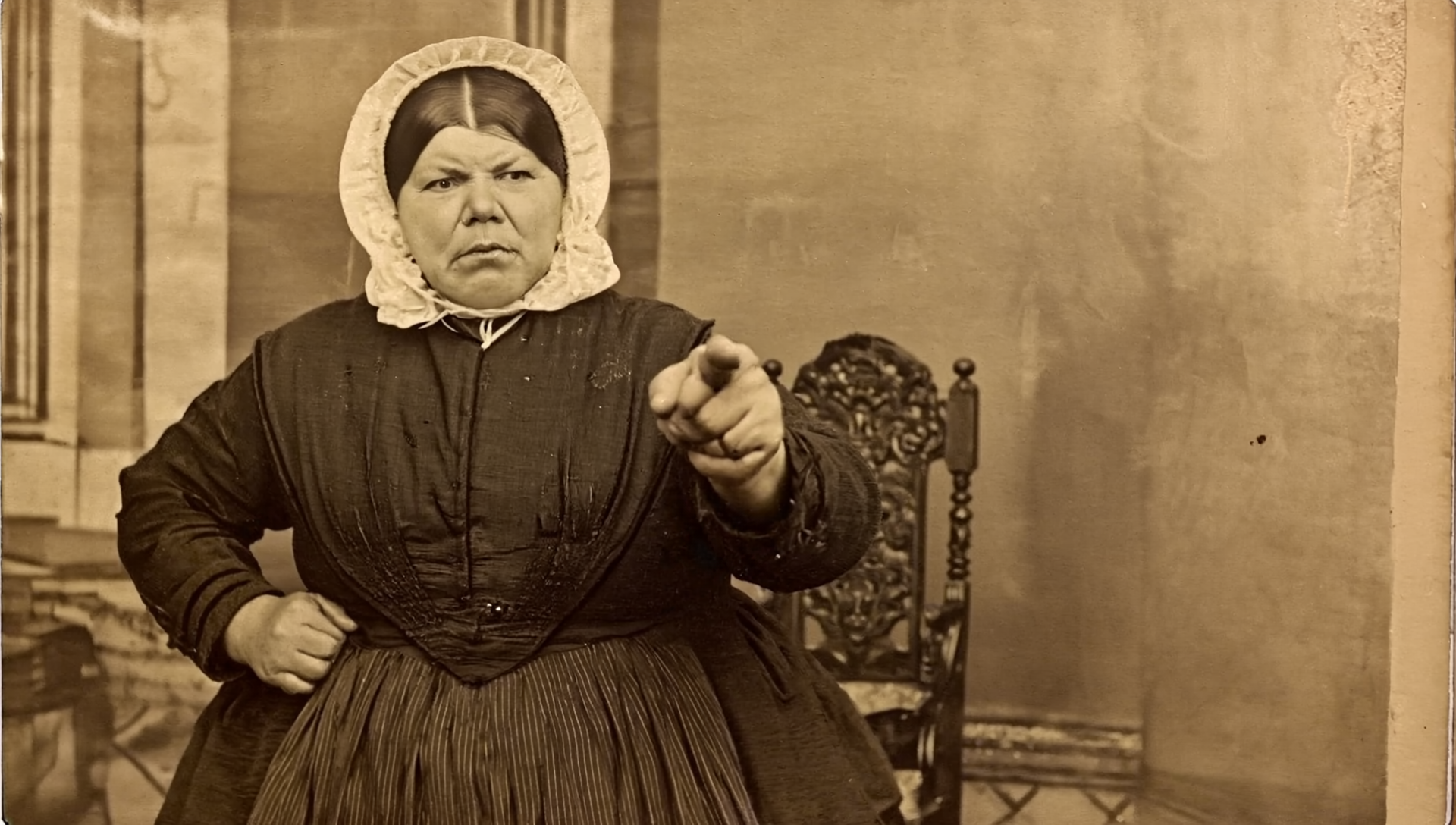
An image from Sew Last Century edited with Runway AI.
She gave birth to sixteen children. Half of them died.
When she immigrated to the United States with her family, one daughter had to stay behind in Europe. The girl was "sickly" and couldn't make the journey. She's lost to history now. I don't know her name. I don't know what happened to her. I only know she was left.
The rest of the family eventually made it to the Plains, where they ran for land. In the photograph, my great-great-grandmother looks angry. But now that I'm older and know what I know, I wonder if she was simply in pain.
Lipedema was first described in medical literature in 1940 by Drs. Edgar Allen and Edgar Hines at the Mayo Clinic. They identified it as a distinct condition — a disorder of adipose tissue affecting almost exclusively women, characterized by symmetric enlargement of the legs, easy bruising, and pain. It was not obesity. It did not respond to diet or exercise. It was something else entirely.
That was eighty-five years ago. And yet lipedema is still barely taught in medical schools even though it’s a genetic condition that an estimated 10%+ of women have.
Most doctors have never heard of it. Those who have often confuse it with lymphedema or dismiss it as obesity, delaying diagnosis and offering incongruent treatments or demand more exercise and less food.
The average patient sees multiple physicians over more than a decade before receiving a correct diagnosis — if she ever receives one at all.
A young doctor asks his extra stethoscope, “Is this thing on?”
Which means that in the 1890s, in the 1920s, in the 1950s, the women in my family had no language for what their bodies were doing. No diagnosis. No explanation. Just legs that grew and grew, and a world that told them it was their fault.
Lipedema is hormonal. It's triggered and worsened by the events that define women's reproductive lives: puberty, pregnancy, menopause. Every hormonal shift is an opportunity for the condition to progress.
My great-great-grandmother had sixteen pregnancies. Sixteen hormonal cascades. Sixteen opportunities for her legs to worsen while she buried half her children and worked the kind of labor that would break most of us.
Her daughter — my great-grandmother — ended up in a wheelchair in the Sandhills of Nebraska in the 1950s. Doctors told her it was gout. But I've seen photographs. I know what gout looks like, and I know what lipedema looks like.
She had lipedema legs. The same legs her mother had. The same legs her daughter and granddaughter have. The same legs I have.
She spent her final years unable to walk, in a rural area with limited medical care, being told her pain was something it wasn't.
My aunt — my father's sister — looked so much like me that people used to joke that I was switched at birth. She had similar symptoms to mine, though I didn't know enough at the time to recognize what I was seeing. She became bed-bound in her forties. She died at fifty-two.
I wasn't close with her. Family politics that had nothing to do with either of us kept us apart. I don't know the full truth of her death — I can't request her death certificate until twenty-five years after she died, and we're only at twenty. I don't know what the official cause was. I don't know if she ever received a diagnosis for any of it.
What I know is that she suffered. What I know is that she was dismissed. What I know is that I'm forty-eight now, and she only had four more years.
Sometimes, when I'm being completely honest with myself, I wonder if she simply couldn't take it anymore.
I wish I could go back in time and take her to a doctor who would actually listen. I wish I could hand her a name for what was happening to her body. I wish I could tell her it wasn't her fault.
My cousin was thirty-two. She had two children — a five-year-old daughter and an infant son.
I was only twelve when it happened, so I learned the story of her death the way children learn things: in fragments, overheard, pieced together later.
She was supposed to return to her mother's house and didn't. Her husband, her mother, and both children got in the car and drove to find her. They pulled up to the house just in time to see her walk out the front door, turn in a circle, and drop.
Aneurysm. She was dead before she hit the ground.
I still can't think about it without crying — the randomness of it, the cruelty of her family witnessing the moment, those babies who would grow up without her. I was a child, and she was the first person I knew who simply stopped existing.
What I didn't know then, and wouldn't learn for decades, is that aneurysms can be connected to connective tissue disorders like Ehlers Danlos Syndrome (EDS). That the same defective collagen that causes hypermobile joints and stretchy skin can also cause weak blood vessel walls. That vascular Ehlers Danlos Syndrome (vEDS) is the most dangerous type, and that it runs in families.
I don't know if my cousin had EDS. I'll never know. But I know what I know now about the bodies in my family, and I wonder.
“But I know what I know now about the bodies in my family, and I wonder.”
There are other women too. Cousins and aunts and women on the periphery of the family tree. Some developed eating disorders. Some became addicted to exercise. Some did both, cycling through restriction and punishment, trying to force their bodies into shapes their bodies were never going to hold.
I've been there. I know what it's like to believe that if you just try hard enough, eat little enough, move enough, you can overcome what is written in your cells. I'll write more about that another time.
What I know now is that none of it worked because it was never going to work. Lipedema doesn't respond to caloric restriction. You cannot outrun your genes.
But we didn't know that. None of us knew. So we blamed ourselves, and we were blamed by others — by doctors, by family, by a culture that sees a woman's body as a project she's failed to complete.
All of us were taught to be critical of our bodies. To feel shame for how we looked. Even though we all looked pretty much the same.
Perimenopause is trying to take me down.
I say that somewhat lightly, but it's true. The hormonal shifts of this stage of life have destabilized everything — my sleep, my mood, my joints, my mast cells, my legs. I've watched my symptoms escalate in ways that feel cruel and arbitrary, and I've had to fight for treatment that should be standard.
And I think about those women — my great-great-grandmother, my great-grandmother, my aunt — going through this same transition with no hormone replacement, no diagnosis, no support. Just their bodies changing and failing in ways no one could explain, in eras when women's health was barely a medical concern at all.
How did they survive it? Some of them didn't.
Five generations of big-legged women. At least five that I can count, and probably more that I can't — the ones who died before cameras, the ones whose names weren't recorded, the ones left behind in Europe because they were too sick to travel.
We didn't have a word for it. We didn't have a diagnosis. We only had bodies that looked a certain way and a world that told us we were wrong for it.
I'm the first woman in my line who knows the name of what she has.
I carry them with me — all of those women. The ones who were told it was gout. The ones who blamed themselves. The ones who died young. The ones who never got answers.
I can't go back and save them. But I can refuse the shame. I can write it down so the next woman in the family with my cluster of symptoms doesn't have to figure it out alone.
